Sunday, January 26, 2014

La Negra Tiene Tumbao: The "Afro" in "Latina"

The Dominican population "has tried to disconnect itself from its African roots to the point where they've constituted a community that's mostly mixed" but calls itself "indios," wrote historian Frank Moya Ponsin in the prologue of the book "Good Hair, Bad Hair."- Huffington Post "Artist & Educators Aim to Tranform Thinking, Laud Black Heritage in Color-Obsessed Dominican Republic"

America parade in Madrid, Spain; Dominican immigrant youth. circa 2008
I was born in beautiful Santo Domingo, the capital city of the Dominican Republic. And while neither of my parents were
Dominican, I still hold on to the island as a part of my identity. My first passport was a Dominican one. In it, my "raza" or "race" is described as being "trigueña." According to urban dictionary the term means:

In the Caribbean (specifically, Dominican Republic) trigueña or trigueño depending on whether the person is male or female, is someone identified of three (tri)cultures. Namely, someone of indigenous (carib, quisqueyano or taino indians) african (from the slaves brought over by ships) and Spanish (Spain)heritage. It has been used in the Latino/Caribbean culture as a term of endearment, a compliment but also at times as a descriptive word when neither 'morena' or 'blanca' seem to completely describe the subject.
I often wonder what the officials filling out my information saw when they saw 8-month old me. Did they see my brown skin and deem it not too light, not too dark? Somewhere in between, just 'right'? Did they look at the shiny black curls and deem them potentially "pelo bueño" (good hair)? The reality was that I was neither indigenous nor Spanish and my West African father arrived in the DR not on a slave ship, but on a plane to attend medical school only a few years before I was born.

Growing up in the United States, very much aware that I was always being seen as black first and foremost, it intrigues me to think that at some point in my early life, in another country, in another racial order I was seen as something else entirely. And as intrigued as I am, I am also deeply disturbed, knowing the lengths to which the DR has gone to shed its ties to blackness and the African diaspora throughout its history. Being called triguena and morena as a "compliment" basically means you're, thankfully, not  a "negra (dark-skinned, black)." It's downright disturbing to me, to be praised for my "canela (cinnamon)" complexion and supposed pelo bueno.  I am invariably complimented on how "nice" my hair is at Dominican salons. But as an adult I still pay an occasional visit to the Dominican hair salons. I go mostly out of nostalgia for getting my hair done with my mom growing up and because my mixed hair means neither the white salons nor the black salons really know what to do. I also feel very at home in those spaces because whether they would identify themselves as such, I see them as Afro-Latinas, like me. 


What Dominican salons have perfected is the art of taking the "African" out of a curly girl's head. And the fact they are so freakin' good at it and will talk about you and how your hair is too thick, or too nappy (ie: pelo malo, said behind your back, assuming you're a black American and can't speak Spanish) means the whole establishment is steeped deeply in race and some intense colorism. One could write volumes on race and colorism in Dominican salons. So if that's so incredibly palpable in a space like a salon (and I've been to ones in Europe and on both coasts of the U.S. and it's the same story) can you imagine what it's like in the motherland?*


Both in the U.S. and in Latin America we have some serious problems with denying the "Afro" in "Latino". Haiti is a devastating example of how maligned African ancestry in the make up and formation of Latin American peoples is. People: Haiti, was the FIRST BLACK REPUBLIC. It was a symbol of freedom, struggle, revolution and triumph. Today Haiti is among the poorest countries in the world. Scores of Haitians risk their lives every year on the treacherous waters between the DR/Haiti and Florida. The DR has had a pathological anti-Haitian mentality that at it's most perverse resulted in the "Parsley Massacre" or El Corte by dictator Trujillo in 1937. More recently, the DR has passed stringent and blatantly racists anti-immigration policies against Haitians. What message is the DR sending? The outright denial and explicit self-loathing of anything to do with it's African ancestry is maddening and so inextricably linked to the colonial project in the DR and the rest of Latin America.  In Costa Rica, where my mother is from, the story is a little different since the black presence in the country came in the form of Jamaican migrants (who were British subjects the time) in the late 1800s. Blacks in Costa Rica were segregated until 1948 despite there being several generations of Caribbean migrants that called the country home. If Latin American societies historically and presently, can't seem to shake their racism and colorism, then how much more complicated does that get when migrants from those countries are confronted with the U.S.'s unique brand of racialization, colorism and racism? 

My mother is Afro-Costa Rican and if we want to talk about color, she's a shade or two darker than I am. Ok, so she isn't my biological mother, we know that now. But my rootedness in my Latina identity has everything to do with seeing her navigate her own identity as an Afro-Latina in the United States. Neither of us are ever read as Latina at first look and that was cause for a lot of frustration for me, and still is.  I was always proud to be both Cameroonian and Costa Rican. I was proud Spanish was my first language. I was proud my favorite foods were mangu, queso frito and flan. I was proud of the black cake my mother made for Christmas every year and the jamaica/sorrel we drank. I was proud of the mixedness of the Caribbean identity of my Costa Rican family. For me being Latina inherently encompasses being of African descent. Those two were always seamless in my family. Being black to me inherently encompasses being Latina. So, I get rabid every time I see a form where I'm asked to check the "Hispanic/Latino" box if I'm Hispanic but not black, and asked to check the "Black/African-American" box if I'm black, but not Hispanic. So ummm... what exactly am I supposed to check? 


The external reading of my latinidad is usually regional-- in New York, I'm sometimes asked if I'm Dominican. I've also been asked if I'm Trinidadian, Guyanese or if I have some "Indian" in me. Which now knowing that my birth mother was (East) Indian seems ironic. Living in Los Angeles, I got to be the invisible Latina. I got to give servers in taco trucks heart attacks with my perfect, rapid-fire Spanish. On the whole, though, most Americans think Latinas look like JLo not Zoe Saldana. And we can laud JLo's African ancestry insofar as it gave her a donk, and lambast Zoe Saldana for not being "black enough" to play a certain role.

Our language is also limited in how much it can capture.  The terms "Latino" and "Hispanic" privilege Spanish-speaking, former colonies of Spain. Yet, Latin America includes former French, Portuguese, British, and Dutch colonies. In addition, a distinction is often made between the "Caribbean" and "Latin America," when in fact they are all part of the same continent and geographic zone.  It's incredibly hard to contain all those multitudes and create an umbrella term for all of them. As with most other identities, we crave new names to better reflect our distinct histories, cultures and realities. But the U.S. racial order thrives on oversimplification and reductionism. So everyone gets lumped together despite having very different identities and subjectivities. Not only do Latinos get lumped together, but depending on your perceived "color" and socioeconomic class you are commanded to step into the black-white colorline accordingly. There's all this talk about how "mixed" Latino identities are and the Latino community is very vocal about celebrating mestizaje, but I think a huge part of the strategy of becoming a recognized political identity in the U.S. system has been to reduce the definition of Latinidad to an limited understanding of mestizo, to simply mean the mixing of indigenous and European ancestry. And while, that might be more true of some countries (like Mexico, Chile, or Argentina to name a few), African ancestry is a huge part of the racial makeup of a number of Latin American countries.

In the U.S., Afro-Latinos get subsumed into the "Black/African-American" box, which is cool and all. That box is used to making room for all kinds of folk depending on what time in history we're looking at. But in that camp, we face similar problems in encompassing the multitudes. Caribbean immigrants and African immigrants are seldom visible members of the "community". Africa is ancestral, not a modern, post-colonial continent. The Caribbean is a tourist destination-- not the historical site of black radicalism, black revolution and the first independent
black nations in the New World. Afro-Latinos are cool until they start speaking too much Spanish or blaring their salsa and merengue down the street. Immigrants are cool until they start "taking jobs". Lines are drawn, borders are demarcated between Black and Latino and to me it makes no sense.

The issue of immigration has become synonymous with Latino political identity.  There are thousands of undocumented black immigrants that are working and being exploited all over the country and even if there weren't, immigration is not just a Latino issue. But according to the media, immigration is apparently ONLY a Latino issue. Few are taking a step back and smelling the rat. Smelling the fact that the arbitrary divisions are made to pit communities against each other and against themselves. How quickly we forget that in cities like New York and Los Angeles, blacks and Latinos have lived and worked side by side for decades. Back in the 60s and 70s the Young Lords modeled themselves after the Black nationalist movement and saw themselves as part of the same struggle of black resistance. Cultural productions like salsa and more recently, reggaeton are unmistakeably Afro-Latino..... look, I could go on this rant for pretty much ever.


I say all this to say, I am incredibly proud of my latinidad and my blackness. I love to think of my mixed identity as part of the complicated and rich histories of people of color in the Americas. I gain a lot being able to think about my mixededness in the context of the hybridity and creolization of Latin America. I navigate being all I am as an American because of my understanding of the cultural and political histories I am a part of. I struggle against the racial order of our country that makes multitudes invisible and reduces complex identities. I really believe talking about race within the Latino experience is a conversation we can all benefit from having. I think it also opens a lot of doors for building political coalitions and fostering solidarity. In my ideal world, this dialogue can also pick up the very crucial conversations about U.S. imperialism, neoliberal policies, exploitation and labor in Latin America and elsewhere that many African-Americans, Chicanos, Nuyoricans and others were very vocal about during the 70s and 80s. These conversations can be cultural, political, global and so incredibly relevant in their scope. Instead, we build walls, we stake claim to certain identities and struggles and not others. We don't see how the struggles and experiences of one group are a window into our own struggles and experiences. And we let a racial system built on oppression, marginalization and white supremacy dictate who we are and who we aren't, instead of standing tall and proud in our collective struggles and histories of resistance to build better, more just and democratic societies.

Note: There has been a growing movement and coalition between Dominicans and Haitians in the diaspora to confront the anti-hatianismo and racism in the DR.

Thursday, September 27, 2012

What My Mother Gave Me


[Blogger's Note: While mixed identity is a very personal and political issue for me, I don't usually use this space to write exclusively about my own life. Though my work and writing make it clear I identify as black, African, Latina, mixed, multi etc, on both the Mixed Dreams twitter and Tumblr sites I've still been asked "what are you?" Since what really spurred me to begin this crusade was so deeply personal and so inscribed in that very question and the realities of my  life, I thought we'd take a break from our "usual programming" to reflect on the evolution of my own mixed story. This post is dedicated to my parents.]


"To lose your mother was to be denied your kin, country, and identity. To lose your mother was to forget your past."
                                                                                                -Dr. Saidiya Hartman

I am the spitting image of my mother.

Three years ago I learned the 'truth' about my origin story. The 'truth', however, didn't make the myth of my early life any less real--any less a rooted marker of who I was and who I am or will become. And that, I owe to my mother.

 Mom and I in 2009
You see, three years ago I was told that I was kinda, sorta adopted-- not legally with paperwork and red tape, not brought from some far off place to an entirely different family, but taken in quietly, seamlessly, secretly by the love and determination of a woman who loved my father very much. That woman became the only mother I have ever known.

My father, who I write about in "Native Speaker," has always been a very strong and visible part of my identity. The Cameroonian name I inherited from him, make my African identity proud and visible against a face that is sometimes hard to place. My Cameroonian family is large and spread all over the world and the blackness I share with them is rooted in a vibrant ancestral past  and a contemporary post-colonial African present.

And yet, in key ways it was my mother who gave me kin, country and identity. 

I did not have the luxury of forgetting. For in order to forget, one must first remember. Instead my early past was simply erased from my young memory by those who rewrote my history to protect, to move on, to survive. In that way my story is no different than the countless mythologies created as people leave homes and re-fashion new identities --always moving, surviving, leaving behind imprints and shadows of their private truths and hazy fictions as they go.

I am the spitting image of my mother. And yet, she was not the woman who gave birth to me. 

My mother is Afro-Costa Rican. We're both "mutts", as she likes to say. Her skin looks just like mine, her first language is my first language, we were both born in Latin America. And, she too, did not grow up with her biological mother. The similarities are striking. Three years ago when I found out she wasn't my 'birth' mother, that my 'birth' mother was Indian, that after all that, I was a classic taboo--a "forbidden love child"-- it was my mother's Afro-Latina/Caribbean identity that anchored me in the face of a simple truth that threatened to uproot and displace me and all I was.

I dedicated my undergraduate life to developing my black consciousness and in particular, my Afro-Latina consciousness. I even spent a summer with my maternal grandmother in Costa Rica unearthing the lost histories of blacks in Limon, Costa Rica-- empowered by their rich transnational narratives, their liminality and their resistance as Africana people. Fluent, familiar Spanish danced effortlessly on my tongue. Rice and peas, escovitch fish and platano tasted like home. I saw my mother's face-- my face-- in everyone I saw and I felt keenly a part of a history, a people, a legacy. It was then that I realized that it was my Afro-Latina identity moreso than my Cameroonian identity that connected me to a living history of blacks in the Americas. It was my Afro-Latina identity that carved out a space for me to understand the breadth of mixedness-- of blackness, its contours, it's depth, it's beautiful distress. It rooted me to a sense of place and home that weaved me seamlessly into a diverse black Atlantic legacy charting it's way from west African shores to Jamaica to Costa Rica to my birthplace in Santo Domingo to Jamaica, Queens where I spent my early years and even Staten Island where I grew up black and middle class in an overwhelmingly white wealthy suburb-- a proud part of the multitude that contained multitudes. 

Don't get me wrong, while grounding, my parent's identities did not spare me my black girl/mixed girl woes. Sure, having two black parents should have been easy enough. But from an early age I could sense that our family identity wasn't quite the 'norm.' The "mixed-up" anxiety I had and the struggles with identity I faced growing up and into my college years were a product of an alienation born from being a "hyphen"-- an "and" in a system where that hyphen is still rendered illegitimate, where multitudes are bound and limited to sound-bite definitions and caging boxes. I was a black girl in a white world. An immigrant daughter in American society. A first-generation African girl in an African-American culture. An Afro-Latina/Caribbean girl in a mestizo Latino world.

Dr. Saidiya Hartman writes "To lose your mother was to be denied your kin, country, and identity. To lose your mother was to forget your past." I lost my birth mother-- Not to death, but to the past, to culture, to tradition, to destiny.... who knows? I was denied entry to an identity, to kin and to a country that should have been my birth right. 

Last year, I traveled to India for nine months to find out more about this identity, this country, this kin that was erased from my history. And as I wrote in my post "And I'm Either No One, Or I'm A Nation" India, too, felt vaguely familiar. For the first time in my life I was not automatically read as "black" and to my incredible surprise I found myself passing. That "passage" felt like an act of trespass and yet it was deeply validating. But as in most spaces, that validation gave way to the more familiar sensation that I am perpetually a stranger in a strange land. And well, that's okay. It's who I am.

Since my time in India and over the last three years I've reflected a great deal on how transgressive my racial history has been-- how constructed and (re)constructed. My experiences have shaken my previous conceptions of what race is, what family is and what identity is. They have profoundly underscored cultural critic Stuart Hall's mantra that "Identity is always in the process of being and becoming." That goes for someone with as complex a history as mine as for a whitebread kid in Ohio. The paradox of identity is that it is meant to ground and define and yet by its very nature it is always in flux. So, what do we hold on to? 

For now, I hold on to my mother. The woman who gave me everything. I hold on with the understanding that this is not who I will always be, but that at the core of my mixed journey is knowing that while we may not always be writers of our past, we are creators of our future. That identities come from somewhere and have histories, but they also have transgressive and yet unwritten futures. I stand proudly in all my truths and contradictions.

Monday, September 10, 2012

Shades of Black (The Flip Side of the 'Zoe-Nina' Debate)

In 1966, the woman born Eunice Kathleen Waymon penned 'The Four Women', which begins, "My skin is Black/ My arms are long/ My hair is wooly/ My back is strong/ Strong enough to take the pain/ Inflicted again and again." Nina had the posture, past and physicality to make this song not only brazen, but also believable and therefore revolutionary in it's telling. How can Saldana possibly bring the pain in an afro-wig and, God-forbid, dark makeup?   - Nicole Moore "Disappearing Acts: Zoe Saldana as Nina Simone & The Erasure of Black Women in Film"
 Zoe Saldana                                              Nina Simone

The blogosphere floodgates flew open two weeks ago  as news broke that actress Zoe Saldana would be playing the role of the iconic Nina Simone in an (allegedly "unauthorized") indie biopic of the late singer and civil rights activist. The film is said to be less of a portrait of the legend and will focus on a speculative love affair between Simone and her assistant/manager Clifton Henderson (to be played by British actor David Oyelowo)

News of Saldana's role unearthed difficult questions about blackness, race and issues of authenticity. While critiques ranged from the legitimacy of the story itself  to the need for more black directors, screenwriters and producers to tell our stories in a more sensitive and critical way than the usual Hollywood "whitewashed" versions, the overwhelming number of critiques focused on the casting of Zoe Saldana in the title role (as an undeniable product of Hollywood "whitewashing".)

And, don't get it twisted, I'm right there questioning whether a story not even authorized by Nina Simone's daughter or her estate should really be going around masquerading as a 'biopic' and helllllll yes we need to take control of our own narratives and representations in the media. But reading the following statements and countless statements like these that made up the hailstorm as the public sounded off on Zoe's casting was troubling to say the least: 


"She's (Saldana) too light-skinned to be taken seriously as Nina Simone."
"And besides--she's a Latina. She's stealing jobs from real black actresses." 
Whether you're a Saldana fan or think she has the acting skills of a pineapple is one thing. But a disturbingly large number of responses to the news said things like "Saldana is too pretty to play Nina Simone" (ummm, and by "prettier" you mean what exactly?? confront your own skewed colorism and then maybe we can have an intelligent conversation.) "Zoe Saldana isn't even black, she's Dominican (responding to that would take a separate post entirely--but let's just say we all came on the same ships, they just stopped in different area codes.) 

I was torn. On one hand, I believe Nina Simone is an iconic figure whose story in film should match her revolutionary spirit which was a profound reflection of her experiences as a black woman. And yet, the discussions surrounding the issue were making me uncomfortable. Was it merely just my light-skinned guilt smarting-- a little light-skinned privilege with no place to go?

 I felt like I wanted to come to Saldana's defense, a fellow Afro-Latina who has invariably been cast in roles that don't recognize her latinidad and yet have established her as a black actress from playing Judith Scott and Bernie Mac's daughter in Guess Who and Nick Cannon's love interest in Drumline (you all know that was a black movie) to the barrier-breaking Uhura in the J.J. Abrams film remake of  Star Trek. Then all of a sudden, Saldana is being accused of capitalizing on blackness for "monetary value" or "taking jobs from "REAL BLACK actresses" when she's only ever been seen or identified herself as black (the operative word in AFRO-Latina; and, since when has being black ever added any 'monetary value?' People, pleeassee.)

Many comments have also failed to recognize the fact that Saldana has been just as much a product of racialization and an industry that has made it a habit of rendering black bodies (and other bodies of color) invisible. Is Saldana's own racial and ethnic erasure in film illegitimate? Why is her body seen as the vehicle of black erasure?  Does her skin color or her Latina heritage make her own struggle as an actress of color navigating one of the most racist industries any less difficult-- any less real? Are we just talking about skin color or something else altogether?

How would we have felt if actress Kerry Washington had been cast  as Nina Simone? Or if Saldana was cast to play black (and since all we can seem to talk about is skin tone--very light-skinned) revolutionary Angela Davis? Is REAL BLACKNESS less about which side of the paper-bag test you fall on and more about an assumed identity politics that go along with it

Nicole Moore's article "Disappearing Acts: Zoe Saldana as Nina Simone and the Erasure of Black Women in Film" states: "Because Simone's blackness extended as much to her musical prowess as to her physicality and image, it's perplexing that the film's production team, led by Jimmy Iovine, expects anyone, particularly in the black community, to (re)imagine Nina Simone as fair-skinned, thin-lipped and narrow-nosed?"

This statement makes me wonder what we're really seeing when we look at Zoe Saldana. Are we measuring her nose and lips (which are really not that much thinner/ "finer" than Nina Simone's)? Or are we looking at her skin tone, her straightened hair, her thin frame, her mainstream fame and summing up the extent of her "pain" and "struggle" accordingly?  Additionally Moore's article likened Saldana's performance to a type of racial "drag" comparing Tyler Perry as Madea to Saldana as Simone even going as far as to suggest Saldana in "black face" asking How can Saldana possibly bring the pain in an afro-wig and, God-forbid, dark makeup? What makes this actress' racial identity so illegitimate, so inauthentic and so far from blackness that she would need to don an 'afro-wig' and 'dark makeup'? Why can't a 'cafe au lait' complected, 'Afro-Latina' Zoe 'bring the pain'??

So, as you can see, I've been all kinds of mixed up. And it's taken me a few weeks to write this.

I've poured over countless drafts and have had one too many late night conversations with any dear friend that will listen about why the "Zoe-Nina" debate has got me sick and damn tired. I've read countless articles and opinion posts (the most critical and well-executed being Nicole Moore's article quote above and this article by Emmanual Akitobi.) And while I agreed with much of what was being said, I felt like not enough was being said about some of the vitriol being spewed in the other direction against a largely anonymous, generalized mass of  "light-skinned women" and "multiracial women" that were being accused of erasing blackness. I also felt that while the blogosphere lent itself to making sure many voices were heard and people could address the controversy head-on, it was also creating a space where no further meaningful discussion could be had because the reaction especially from black women was, understandably, visceral and swift.

I've swung back and forth between saying what's on my mind or holding  (read: policing) my tongue because I understand profoundly that colorism is real-- that light-skinned privilege is real--that talking about colorism as a black woman hurts and  that talking about light-skinned privilege as a mixed woman is treading dangerously through a painful minefield.

While I love me some Zoe Saldana, I'd be the first to say I'm very doubtful she would live up to the role.  I do believe that Hollywood has a serious and disturbing color problem.  And I do believe that lighter black actresses, are more palatable to a gaze that has yet to confront its own oppressive and marginalizing tendencies (read: its white supremacist nature)-- and no where is that more keenly felt than on the body of dark-skinned black women. 
 
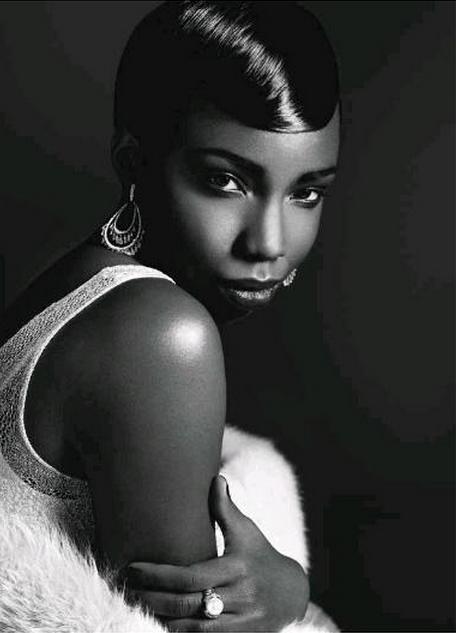
Adepero Oduye
Paula Patton
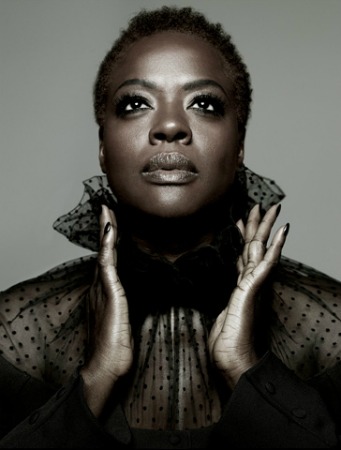
Viola Davis
But let's not bash the actresses. In discussions about the debate, along with Saldana, actresses Jacqueline Flemming, Paula Patton, Thandie Newton and Halle Berry have been grouped as the ostensive "Wannabes" against actresses like Adepero Oduye, Viola Davis, Anika Noni Rose, and singers India Arie and Lauryn Hill who have all been suggested as recasting alternatives for the Simone film.

What I find interesting is that all of the actresses in the first group would have been called black just a a few short years ago and now they are being called "bi-racial" and "light-skinned" to differentiate them for "real black" women.  All of these women at one point or another have identified themselves as black, some even clearly stating they are NOT MULTIRACIAL. 

Ultimately, no matter what shade we are, we're still pawns in a system that doesn't value or respect blackness-- its beauty, its history or its incredible diversity. And, the very fact we're  having this conversation is because black women (whether we're dark or we're fair) are still scrambling for scraps and an equal place at the table. 
And light skin does not have to be inherently anti-black. In the United States, it is a reality and a reminder that white blood and mixed blood have been an inextricable part of black history. Let's not forget that the one-drop rule was made to confront multiraciality and to police light skin. And today the value on lighter and bright is no less an instrument of the same system-- just a different manifestation. It has been used as a tool to divide and marginalize black folk. And that's where my heart kinda breaks a little. Let's dismantle the system, not each other.** 

** There is a strong petition in Change.org calling on Jimmy Iovine and Cynthia Mort to recast Saldana and what I really appreciate is that it explicitly makes it about the system and not Saldana. 
In 1966, the woman born Eunice Kathleen Waymon did indeed write 'The Four Women'. It was a song about the realities and pain of black womanhood. Each of the four women was a different shade-- black, yellow, tan and brown.  Their collective and individual pain was just as real... And each was just as black as the next.


My skin is black My arms are longMy hair is woolly My back is strong Strong enough to take the pain Inflicted again and again What do they call me My name is Aunt Sarah My name is Aunt Sarah Aunt Sarah 

My skin is yellow My hair is long Between two worlds I do belong My father was rich and white He forced my mother late one night What do they call me My name is Saffronia My name is Saffronia 

My skin is tan My hair is fine My hips invite you My mouth like wine Whose little girl am I? Anyone who has money to buy What do they call me My name is Sweet Thing My name is Sweet Thing 

 My skin is brown And my manner is tough I'll kill the first mother I see My life has to been rough I'm awfully bitter these days Because my parents were slaves What do they call me My name is PEACHES

Thursday, May 24, 2012

The Hypervisible Man: Obama as the First Black, Mixed-Race, Asian American and now Gay President

“I have always sensed that he [Obama] intuitively understands gays and our predicament—because it so mirrors his own. And he knows how the love and sacrifice of marriage can heal, integrate, and rebuild a soul. The point of the gay-rights movement, after all, is not about helping people be gay. It is about creating the space for people to be themselves. This has been Obama’s life’s work. And he just enlarged the space in this world for so many others, trapped in different cages of identity, yearning to be released and returned to the families they love and the dignity they deserve.”  -Andrew Sullivan, "The First Gay President" Newsweek

I admit, I've missed quite a bit being oceans and continents away from the US of A. But one watershed moment managed to reach my little apartment in Udaipur last week as I was sipping my morning chai. Front page of the Times of India was Obama's declaration of support for marriage equality. Between you and I, I was always of the camp that believed Obama's previous stance was no more than a mere (albeit calculated and predictable) front to protect his political hide as the over-hyped newbie presidential candidate. Seems my sentiments were shared by Andrew Sullivan in his cover article in this week's edition of Newsweek, which featured the above image and the headline "The First Gay President."

Reading Sullivan's article, I remembered a talk I attended at Oberlin College for Asian Pacific American Month in 2010 where the speaker's last slide was entitled "The First Asian-American President" beneath two photographs of Obama, one as a child in Indonesia and one hugging his sister Maya Soetoro-Ng at his high school graduation in Hawaii. The speaker insisted that Obama's early childhood spent in Indonesia with  his mother and stepfather, his youth spent in Hawaii, his identity as a hyphen American, and immigrant son made his experience akin to that of many Asian-Americans and thus earned him the title "First Asian-American President." And in those terms it totally made sense. Obama could be Asian-American. Obama's identity lends itself quite easily to repeated acts of reading and (re)interpretation. Though he's self-identified as African-American, many still call him "The First Multiracial President." Because it matters much less what Obama thinks of himself than what we the people think of him--what images we project onto his being.

In my course, I used Obama's story, his identity as a tool to understand how multiraciality contains multitudes and how a multiracial critique could be instrumental in breaking down monolithic notions of identity. So I encouraged students to talk about multiraciality as part of black identities, as part of Asian-American identities, Latin@, Native, White, adoptee and queer identities. If anything multiraciality benefits a great deal from a queer critique-- queering race. And there's increasingly more out there in Academe that works at the rich intersection. That being said, I still found myself a bit surprised to see such a bold act of race queering on the cover of a mainstream American publication such as Newsweek.

I don't know if Sullivan was quite sure that he was actively queering race as he compared Obama's racial exodus to the experiences of queer folk. And while I think using a queer critique as a tool is vital to destabilizing notions of identity, it's also crucial to understand that "gay" and "queer" are highly political and politicized words and not colorful labels you tag willy-nilly. So just as it was kinda cute to say Clinton was the "First Black President," (no one, least of all black folk, really believed that), so to, does Obama's new title only serve its true function as symbolism if not just mere sentiment.

The article linking Obama's racial identity to queer experiences does give me hope for a shift in the conversation not just regarding marriage equality but to that notion I'm often going on about: our identities are fluid, y'all. Full stop.

Whether Obama is reelected for a second term, whether he goes down in history as a saint or a villain, a triumph or a failure, one thing is for certain: Obama's legacy will be marked by his symbolic currency. It is a Obama's ability to quite literally absorb our nation's imaginings, our own distinct senses of belonging/and yet not belonging, into his words and onto his "mixed/queer" body and weave it back into his life story and identity that makes him most powerful. I'd like to see you try to do that, Mitt Romney.

The Newsweek cover image itself warrants a little playful analysis: our still disarmingly debonair, now-seasoned President, appearing a little grayer, brow now gently (though, I fear permanently) furrowed, gazing stoically off into some unknown distance. What I find most intriguing is that rainbow halo floating proudly in a glow above his head. Obama as saint, Obama as martyr-icon, potentially committing a yet to be determined act of political suicide/sacrifice?  The halo- perhaps a crown marking his coronation by the queer community?....

Frankly, I think Obama's not in any real danger at this point. A little recklessness would do him a world of good. If anything, that glowing halo will serve the newly sainted/crowned Obama well in the upcoming election, helping him cement the support of the increasingly apathetic millenials who are credited for his sweeping 2008 win, and of course the mainstream gay community whose monetary backing is crucial. But let's not talk politics. For perhaps most significantly, once again, his words, his actions, his body, have changed the national conversation. Obama as symbol, Obama as icon, Obama as chameleon, Obama as both perpetual canvas and national mirror will long outlive Obama as politician...Obama as mere president.

From Newsweek, "The First Gay President" May 21, 2012

"[T]here is something on this subject [marriage equality] with Obama that goes deeper in my view than cold, calculating politics and a commitment to civil rights. The core gay experience throughout history has been displacement, a sense of belonging and yet not belonging. Gays are born mostly into heterosexual families and discover as they grow up that, for some reason, they will never be able to have a marriage like their parents’ or their siblings’. They know this before they can tell anyone else, even their parents. This sense of subtle alienation—of loving your own family while feeling excluded from it—is something all gay children learn. They sense something inchoate, a separateness from their peers, a subtle estrangement from their families, the first sharp pangs of shame. And then, at some point, they find out what it all means. In the past, they often would retreat and withdraw, holding a secret they couldn’t even share with their parents—living as an insider outsider.

“And this, in a different way, is Obama’s life story as well. He was a black kid brought up by white grandparents and a white single mother in Hawaii and Indonesia, where his color really made no difference. He discovered his otherness when reading an old issue of Life magazine, which had a feature on African-Americans who had undergone an irreversible bleaching treatment to make them look white—because they believed being white was the only way to be happy. . . .
“Barack Obama had to come out of a different closet. He had to discover his black identity and then reconcile it with his white family, just as gays discover their homosexual identity and then have to reconcile it with their heterosexual family. . . .


“This is the gay experience: the discovery in adulthood of a community not like your own home and the struggle to belong in both places, without displacement, without alienation. It is easier today than ever. But it is never truly without emotional scar tissue. Obama learned to be black the way gays learn to be gay. . . ."


Friday, October 21, 2011

And Either I’m Nobody, Or I’m A Nation

Climbing into a rickshaw or walking through the busy streets of Udaipur, Rajasthan, I see an expression I never knew I longed for. 

My poor Hindi, my all too eager smile, and my unsure footsteps in this unknown city belie my foreignness.
But, perhaps, in all other ways my face, my color can easily be lost in the interminable swirl of browns and thick blur of vivid all around me.

I arrived in India two weeks ago, the end (or perhaps just the beginning) of a deeply personal journey I began over three years ago to figure out what it meant (if anything) for me to be Indian. What does it mean, when I had been raised African and Afro-Costa Rican; when my memories are wrapped up in the black and brown faces of my family and their stories of “back home”;  when even my very politics are steeped in blackness and latindad and when language and culture anchor and bind me to proud histories that trace the routes of slavery and migration from Africa, to the Caribbean, Central and North America?

It seems fitting then, that the Universe took her poetic license and fashioned the Dominican Republic--really the Caribbean--as the cuna, the cradle of my multitudes. My creation story, my own brief and wondrous life began in the “Ground Zero of the New World.” There begins my myth threaded into the countless other magic fictions born there  everyday.


India too, like Africa, feels like an ancestral place to my very being. Something about its haze, its smell, its taste, its movement is reminiscent of the other "back homes" etched in my rememory. In Hindi, 'to remember' and 'to miss' (as in I miss you), are the same word... And I miss what I cannot remember.

Some days India feels like a coming home, a place of rest. Maybe it’s all the Octavia Butler sci-fi I’ve
been reading, but thousands of feet in the air, tossing in my seat on my Air India flight, listening to "Shiva Mantra" and "Aisa Des Hai Mera"  on repeat, I had a fever dream, a dozy hallucination that had me wondering if land, earth, tierra... had flesh memories. If the minute I stepped on Indian soil, she would know me. Understand me, if only in theory, as one of her own. Perhaps it's the same way we Africans in the diaspora long for the continent, long for recognition, familiarity. I wanted it to be a fiercely intimate pact between us that, “You are a part of me, and yes, I am a part of you.”-- A mutual agreement, a validation. Something I have no need to defend to anyone, Indian, African, Latin@ or otherwise. 

Home and nation, culture and race, history and destiny, truth and myth.... questions yet unformed, answers still hidden and scattered across the world.

My story Osiris. And I, I could be Isis.

* Inspired by Junot Diaz’s novel The Brief and Wondrous Life of Oscar Wao and Derek Walcott's poem at the beginning of the novel

Thursday, October 20, 2011

Oberlin College's Multiracial Student Resource Pamphlet

Here's the Oberlin Multiracial Student Resources pamphlet I put together this past summer.


A few things didn't make it into the final version. This section came out of a discussion with the students from the ExCo. I've included them below:

A Mixed Toolbox 

MIXED ME: Empowering Multiracial Identities

“To thine own self...”: Self-identifying:  Develop confidence in identifying yourself and demand that others respect your identity.

“The more you knowwww”- Education: Explore your own background as well as resources, writing, scholarship dealing with multiracial experiences, histories of people of color and issues of social, economic and racial justice.

Power To the People: Developing Critical Consciousness: Understand the role of power & privilege and systemic structures on your identity and how it relates to that of other historically marginalized or underrepresented groups. 

In Solidarity: Be An Ally: Support other multiracial people, but also other historically underrepresented and marginalized groups.

BEING A MIXED ALLY 

Understand that the question “What are you?” can be a very sensitive one for multiracial people.

Be conscious of how simple remarks or even compliments can “other” or “exotify” multiracial people.

Be mindful not to homogenize mixed experiences and identities. Multiracial identities are diverse and complex. They may  be distinct from other identities and experiences, but there are also many commonalities and shared histories.

Recognize that multiracial people indeed exist and include multiraciality in discussions on race and multicultural activities and events.

Respect everyone’s process. Respect that individuals have the right to self-identify and that policing mixed identities or ignoring them altogether can be alienating to multiracial people.

Take time to explore and read up on multiracial issues. Yet perhaps most importantly, take time to explore your own identities and the spaces you occupy in the social system as it relates to power and privilege.


* Please see the MRC’s Privilege, Allyship & Safe Space Resource pamphlet for more information and definitions.

Mixed Dreams Guest: Rita Kamani-Renedo

On a New York-based, historically situated Multi Narrative
by Rita Kamani-Renedo 

On Monday, September 26th, I traveled to Brooklyn after work to attend an event at the Brooklyn Historical Society called “Who Are You? A discussion about mixed heritage.” I didn’t know what to expect but I was ecstatic (well, as ecstatic as one can be on a Monday after a full day of work). My “multi” friends and I had long contemplated the need for a conversation about multiraciality and mixed-heritage that is situated within New York’s unique historical context—a fabric that is woven from narratives of immigration, urban decay and plight, gentrification, racial altercations, ethnic enclaves, and post-9/11 politics. Many conversations that I have been a part of have assumed that multiracial means “White and something else.” Those of us who are the products of two people of color or two (or more) distinct immigrant identities have sometimes felt that conversations around racial mixing have excluded our experiences, and there was always something about a New York-focused discourse that seemed would embrace our experiences much more. We “East Coasters” have often lamented the lack of public dialogues, artistic projects or action campaigns around mixed issues in places like New York or Washington when we look west towards California and the Pacific Northwest, where organizations like the Mavin Foundation, the Mixed Roots Film and Literary Festival and the Association of MultiEthnic Americans seem be constantly reshaping public dialogue on issues of multiraciality. But the West Coast’s history of racial mixing is uniquely shaped by its histories of expansionist policies, the encounters/destruction of the region’s Native American, Spanish, French and Anglo inhabitants, immigration through Angel Island, the Gold Rush and the construction of railroads that brought thousands of Chinese workers to the region, and of course, the region’s geographic proximity to Asia, Mexico and Central America. The demographic, racial, and cultural landscapes of the region’s urban centers have also transformed racial and ethnic identities in ways that are vastly different from the ways that identities and histories have crossed borders in New York. Thus, a conversation that considers New York’s distinct historical, economic, ethnic, racial and cultural terrain is necessary, now more than ever.

This is precisely the vision of the folks at the Brooklyn Historical Society (BHS) who have initiated the Crossing Borders, Bridging Generations (CBBG) public programming and oral history project. This initiative seeks to provide a forum for dialogue around “mixed-heritage families, race, ethnicity, cultural and identity, infused with historical perspective.” Such an historical perspective will allow the project’s participants to explore the stories of mixed-heritage individuals and communities who have been shaped and who have shaped Brooklyn’s own racial history. Upcoming events will examine the 1991 Crown Heights Riots, Spike Lee’s iconic Jungle Fever, and Kip Fulbeck’s The Hapa Project. This conversation is bound to draw upon Brooklyn’s rich cultural mélange—Jews, Poles, Haitians, Russians, Dominicans, Italians, Puerto Ricans, African Americans, West Indians, Mexicans, Chinese, not to mention the hipsters, the hip-hop-ers, the musicians, writers, artists and activists who call Brooklyn home. I am gradually learning more about the CBBG, and last night’s event helped me to understand more about the vision and scope of this exciting project.

The evening began with an introduction by Jen Chau, the Founder and Executive Director of Swirl. Jen’s comments (which started with a personal anecdote about the time a 2000 Census workers curiously asked Jen what country “Biracial” is) were followed by brief presentations by Judith Sloan, co-author and co-creator of Crossing the BLVD: Strangers, neighbors, aliens in a new America, Suleiman Osman, author of The Invention of Brownstone Brooklyn: Gentrification, Race and the Search for Authenticity in Post-War New York, and Katrina Grigg-Saito, creator of the documentary and installation, FishBird. All three of the panelists focused on the historical context and the geographic complexities of multiraciality. Katrina Grigg-Saito’s project actually emerged when she heard a woman in the UK say, in reference to mixed-race people, “a fish can love a bird but where would they live?” This question really touches upon one of the central questions explored at Monday’s event and one that I have long pondered – what does location have to do with one’s experience as a person of mixed-heritage? This really begs two more sub questions that I am exploring in this post and will continue to throughout this project. First, if there is a need for conversation around mixed-heritage that is situated within a particular geographic and historical context—Brooklyn, to be exact—what will that conversation look like? Second, for those of us who identify as mixed-heritage, how does our geographic location—and all the cultural, racial, economic, political and social implications it bears—impact or shape our experiences? Are there certain places—cities or countries, perhaps—that can feel more like “home” to mixed-heritage folks?

This last question takes me back to one mixed dreamer’s recent post about the concrete jungle itself. As Nicole so eloquently said, “In New York, my identity and all that I am seems to make sense. The ‘uniqueness’ of my own life is but a thread in the fabric, part of the millions of interwoven identities and narratives of migration, change, process and formation that make the city a home for the transient, a place for the liminal, those existing here and there and yet all the while staking claim and setting roots deep in the here.” If you haven’t yet, check out Nicole’s reflections on space, place, race and how “region and geography play such a critical role in identity formation”. She refers to how the city’s histories of migration, movement, and conflict have brought together Blackness and Latinidad in ways that have not been possible in other parts of the United States. The city’s Puerto Ricans, Dominicans, Trinidadians, Jamaicans, Guyanese, Haitians, and so many more embody Afro-latinidad and reaffirm the multi identities that emerged from the mixing of people across continents, cultures, and colors.

This makes me think about my own unique history. When I tell people I was born in Queens, we often make jokes – “Where else would an Indian man from Ethiopia and a Chilean woman meet and make a baby?” Queens—the most diverse county in the United States of America. Ride the 7 train and in addition to passing the historic and extraordinary tattooed walls of 5Pointz, you’ll pass through Pakistan, Ecuador, Colombia, Russia, China, India, Turkey, Bangladesh…all without a passport! Now, I’m the last person to feed you the “melting pot” story that so many New York-lovers sing and dance. There are lines, borders, walls, boundaries, all throughout New York. I live on a block that is primarily Dominican. You cross the street and move away from Broadway towards Amsterdam, and you’re on a block that is almost exclusively African American or African. One block in Jackson Heights will have you speaking Spanish and eating arepas, while on the next one smells of curry and sounds of Amitabh Bachchan overwhelm your senses. And while gentrification might be pushing these lines in one direction or another, the stark differences and inequalities can still be found. My love of Queens does not equate to any kind of claim that all the Colombians and Russians and Chinese and Pakistanis are getting together and making Col-Rus-Chin-stanis (I tried). It’s not that simple, and that’s not what “multi” is about. But, there’s GOTTA be something about the geographic intimacy of so many different nationalities that allows for the unique coming together of histories and identities that otherwise may never interact.

Perhaps this hunch is what always drew me to New York growing up. I was born here but sadly, not raised. It wasn’t until my late teens and early twenties that I started spending time here and eventually moved back to the city of my birth. It was then that I realized there was something that felt like home about this fast-paced, walk-fast, look-straight-ahead, hustle-and-bustle, belly-of-the-beast world. Despite the city’s vastness and the fact that to visit a friend I sometimes have to travel 1.5 hours on a train, I have gained a sense of community here that I could never create in any other cosmopolitan center. Perhaps it’s because, as Staceyann Chin so beautifully explains, “I fit in because there was no criterion for belonging.” I believe that in New York City, you can be many things at once. Perhaps the boxes are not as rigid or people don’t expect you to fit into them so much. Or maybe, you just get to pick many and move throughout them as you please. As Staceyann Chin, a Black, Chinese, queer feminist from Jamaica, said about her beloved Brooklyn, “These noisy streets offer ample room, and by extension time, to hate Jamaica, to fall in love with Jamaica, and finally, to find the medium through which I can separate the impossible from the possible and become my most comfortable self.” I believe that in being in New York, you can still continue to be in other places, other countries, other worlds. Perhaps I am my most comfortable self when I can carry my histories within me and know that around me, identities that are as disparate as my own are colliding and changing every day around me.