Fiona, Jo Burg, complex of mixed girls/
For surviving through every lie they put into us now/The world is yours and I swear I will stand focused/Black girls, raise up your hands; the world should clap for us... Jean Grae from Talib Kweli's Black Girl Pain
For surviving through every lie they put into us now/The world is yours and I swear I will stand focused/Black girls, raise up your hands; the world should clap for us... Jean Grae from Talib Kweli's Black Girl Pain
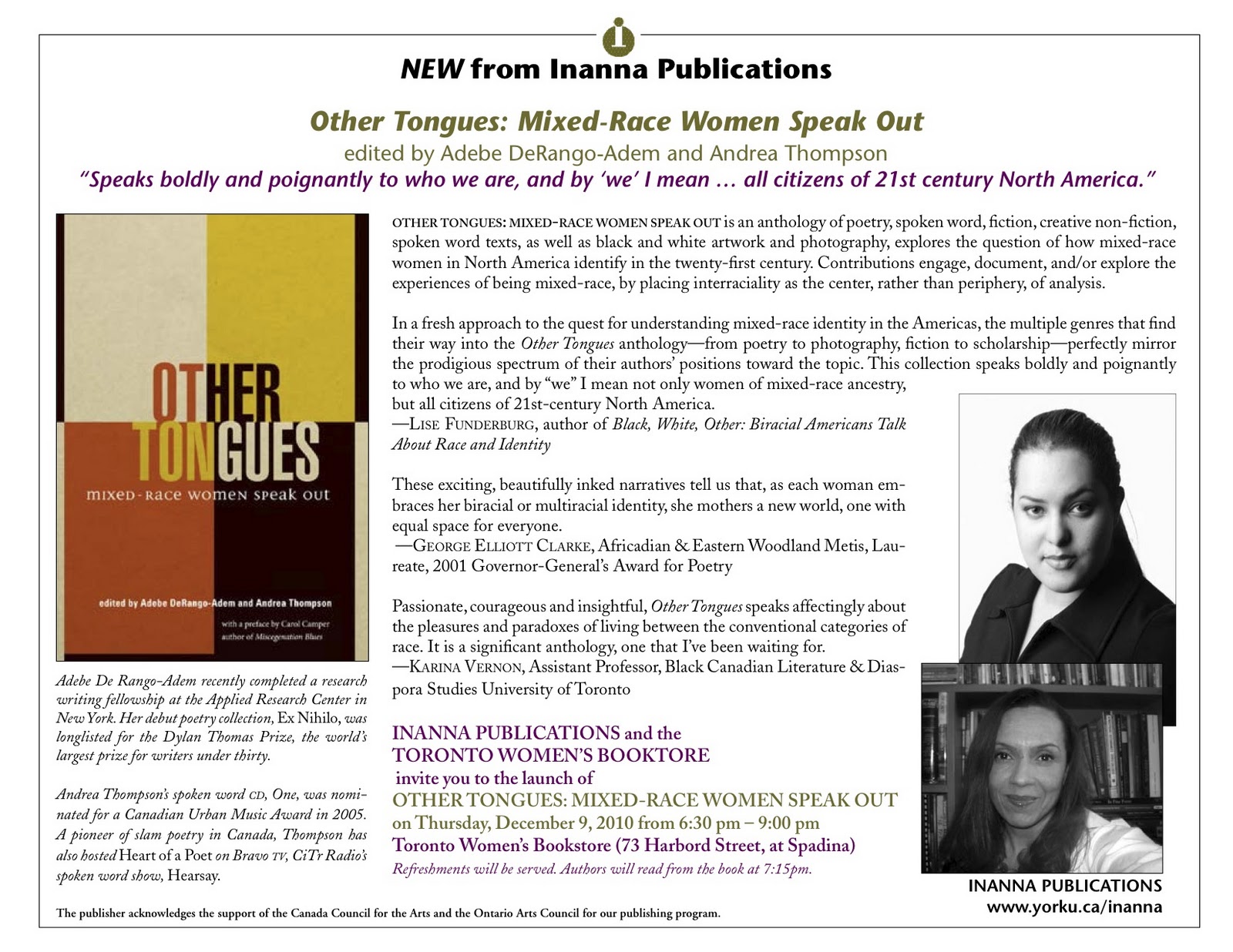
I recently googled "mixed-race women." Among the first things that pop-up after the photos of Halle Berry, Thandie Newton and Alicia Keys were the following results: 1) Dating mixed race women Free Dating, Singles and Personals 2) Other Tongues: Mixed-Race Women Speak Out: Amazon.ca (a recent addition!) 3)Mixed race women are put in place of black beauty and 4)Why are mixed race women usually associated with beauty and black women are not? followed by a few other pages full of dating and personal ads as well as forum threads about "beautiful" or "hot" mixed-race women and models.
To the arguable extent that Google can be a viable indicator of any popular thought, it does show that at least in cyber-space most of what's out there about mixed-race women fixates on our physique and our bodies particularly in relation to "monoracial" black women. As a mixed-race, black woman myself, I've struggled to break down the stereotypes in my own communities that often favor "light-skinned,"red-boned" women with pelo bueno (good hair) while painfully pitting mixed beauty against black beauty. These conceptions beg the question:
Is mixed beauty inevitably 'anti-black' beauty?
Is mixed beauty inevitably 'anti-black' beauty?


 There's a common misconception that mixed black women have it all. After all, the media seems to favor us or at least light-skinned women that look like us, from Hollywood to our very own black entertainment industry (if it indeed, is "ours"). Colorism is nothing new. It's a painful and persistent inheritance of internalized racism and self-hatred-- the eternal struggle between the "Wanabees" and the "Jigaboos" comically immortalized in Spike Lee's acclaimed satirical film School Daze. Are we either "high yella heifas" or "tar-babies"?... Wanabees, or Jigaboos...
But sisters, whether you're 'dark or you're fair' we've all been damaged. We've all been used and exploited. Our bodies, the violent battleground of inequality--and to add insult to injury we just keep driving that imagined chasm between us deeper and deeper. Light-skinned privilege is real. More "European" features are generally favored--true story. But black folk come in different shades, sizes and hair textures that make visible just how mixed our history as a people has been. Yet our beauty is irrevocably constructed in relation to whiteness and widespread healing from the collective trauma of oppression inflicted and then self-inflicted (most notably, through damaging products like lye-relaxer and bleaching cream) has only just begun. And mixed girls have not been immune. For first generation mixed women of African descent learning to love our blackness and our mixedness is a long process if we ever even get there. And I am, ultimately, left with too many hard questions...
Mixed-black sisters out there: how many times have we considered the privilege we embody? How do we resist the use of our bodies by media, or even by our own families to further marginalize black beauty and objectify ourselves? Will we always be seen as "Wannabees?" Must our bodies always be seen as somehow "anti-black"? Can we love the kinks, the curls, the dark, the light and everything in between? Is mixed pride inherently anti-black pride?
Mixed girls, black girls and mixed-black girls, can we (re)imagine a beauty where we can all be celebrated as the queens we are or will we continue to play into the hands of exclusive standards of beauty? In the words of Ntozake Shange, will we ever find ourselves at the end of our rainbows and will we learn to love each other fiercely?
I desperately hope so.