Monday, January 31, 2011

Back to The Future: A Response to 'Young & Mixed in America'

"One in 19 people are born mixed race and if you keep mixing there's going to be an average color that pops out...probably not in the next decade, but probably in the next century or so things will have changed a lot because things are changing exponentially and because of that race will no longer be the big hot topic...at least not the way it is now.   Most people will be in some way mixed" NYT 1.20.11 "Young & Mixed in America"
Since the late 90s, every few years an article or segment appears in our mainstream media about mixed-race people in the U.S. The New York Times, in particular, has often kept its fingers on the multiracial pulse.
In 2001, it was a NYT article declaring that now, given the choice, 6.8 million Americans checked more than one box in the decennial census. This was followed by another article that same year: "Multiracial Identification May Affect Programs" which expressed concerns about what increased multiracial identification could do to state/federal programs and policies based on enforcing long fought for civil rights. In 2003, the NYT article "Generation E.A.: Ethnically Ambiguous," focused on media and advertising. In 2005 "When You Contain Multitudes,"(oddly enough published like a new trend under "Fashion & Style") covered MAVIN Foundation's highly anticipated "Generation Mix Tour."  The video "Being Mixed in America" and an article "Who Are We Now: New Dialogue on Mixed Race were featured in 2008. Throughout 2007 and 2008, a few other articles appeared discussing what President Obama's mixed heritage could mean about the future of race in the U.S. Most recently, this past Saturday, January 29th, 2011 the NYT featured a video and an article entitled "Young and Mixed in America" which cover the rise of multiracial-identified students and organizing on college campuses.
...Now, I've only been alive for twenty four years and I vaguely remember anything before the late 90s. But I've been getting this weird sensation lately, that when it comes to discussing mixed issues in this country we're like a broken record-- repeating the same basic information for the past 10 years-- Surprise! There's mixed people in the U.S. They are visible and starting to be more vocal about their identity. Soon we'll all be mixed. Yay! Full stop.
But when do we move past that? When does the cover story move further and more profoundly into the issue? Mixed people seem to be always in a process of "becoming", on the brink of fully "being" and reinventing the wheel every few years-- particularly younger generations.

I remember being a "multi baby" once in college, navigating my multiple identities and my spaces and finding and defining community for myself. The MAVIN Foundation was alive and well then, and I remember watching the film Chasing Daybreak about the Generation Mix Tour in a room full of other mixed students. Some students were mobilizing to specifically register other mixed people to be bone marrow donors. Others attended conferences solely dedicated to mixed students at other colleges. I remember when the first Kip Fulbeck book Part Asian, 100% Hapa came out and everyone wanted Kip to grace their campus. I also attended a small liberal arts college and was privileged to have a space where I could figure out what being mixed meant to me. Granted, it was always an uphill battle to figure out the needs of the mixed student community and there were always issues with support vs. activism, leadership, membership and organizing as with any student org. But, it was a start and one that many college students (let alone K-12 students) don't ever get to experience.

I work in higher education now and have found myself advocating for multiracial college students in a big way because it's true... the numbers don't lie and students are being even more vocal about the ways in which they choose to identify--mixed race or otherwise. But still, there are an overwhelming number of mixed students who come in feeling like they've been the "only ones" in their high schools and hometowns; mixed students struggling to navigate their spaces, not getting validation for their experiences and not hearing from either their peers or their professors about their history (yes, we have one-- several actually).

So, on the one hand it's amazing to know that there's visibility and recognition of the mixed community. Yet on the other, many of the articles I listed above speculate in some way, shape or form, what a mixed identity-- really, what a mixed body could mean for the "future" of race in America. I'm done with it. I kinda want to say... it's not about you right now, America. It's not about what "average color" is going to eventually "pop out"-- the browning vs. the whitening of America. My body will not be used as a launchpad toward some raceless, colorblind national myth or even as a resting place for dreams of race reconciliation. Not right now. Centuries of history has shown that mixing doesn't make race irrelevant. In key ways, race in the U.S. was constructed to confront the already existing reality of race mixing. So that can't possibly be the answer to our racial dilemmas. Since "multiracial" wasn't (and still isn't) a federally accepted racial categrory, no real comprehensive data exists before 2000 about how many people actually were of mixed race. But I'm sure that at the height of slavery, there was no doubt a sizeable amount of mixed people in the United States. They just weren't being counted, that's all.

What has changed drastically is the fact that "multiracial" is becoming more visible as a legitimate identity on its own. So, what I am more concerned with, is less about what this means for the racial redemption of America, but rather about how we empower and support that identity development-- critically and sustainably as parents and family, as educators, as peers, as policy makers and as a society. How can we educate, build community and reveal our histories-- those that already exist between the lines of various intersecting national and global histories? How can we contain all our multiple identities in a still rigid racial classification system and understand what it means to be mixed and black, mixed and Asian, mixed and white, transracially/transnationally adopted etc?

There's a spotty institutional memory that hasn't been passed down as fully as it could be and organizations who were at the forefront of advocacy work like MAVIN/The Mixed Heritage Center, MASC, iPride, AMEA are active (some less so than others) and media like the weekly podcast Mixed Chicks Chat among many others are still out there doing their thing. But few that aren't out on the west coast or weren't in some way connected to the early movement know anything about their existence. So we're left wandering around in the dark, trying to reinvent the wheel and making the same news over and over.

I want this generation and the next generation of mixed kids and adults to know that there was a movement, however flawed, however much a blip compared to things like the civil rights movement, but a movement nonetheless of activists and advocates, families and  young multiracial people that fought for recognition in the face of controversy and a centuries old system of power that served to either deny or grant people humanity based solely on the color of their skin.

Being mixed isn't some developmental phase you deal with in college and move past by your mid 20s. Nor is it a passing demographic or social trend. It's an identity and a lived experience.
It's ten years later, mixed folk. How far have we really gone? And how conscious are we of where we're headed?

Wednesday, January 26, 2011

4th Annual Mixed Roots Film & Literary Festival Coming this JUNE!!

The fabulous duo of Mixed Chicks Chat and their team of amazing organizers will be hosting the 4th Annual Mixed Roots Film and Literary Festival in Los Angeles, California this June 11th- 12th at the Japanese American National Museum. The festival is currently seeking nominations for their event line-up! See their call for nominations below and if you have any great nominees fill out the survey by February 14th.

Seeking YOUR nominations!

What's the proudest Mixed moment of 2010?
What film or book best depicts the Mixed experience?*


We're gearing up for the:

June 11-12, 2011
to be held at the
Japanese American National Museum
Los Angeles, CA!

And we need your help!  We are creating the Festival line-up and we'd like for
you to be a big part of the process.

This year we are going to have an Awards Presentation based on your nominations!  So we are asking you to nominate films, media, and literature in the following categories. And please feel free to make suggestions for more categories!

...drum roll, please...

The 4th Annual Mixed Roots Festival Nomination Categories are:
  • Best film or book depicting an interracial/intercultural relationship
  • Best film or book starring a person with a Mixed background
  • Best reveal of a person who is "passing"
  • Most historically accurate representation of the Mixed experience
  • Best commercial representing the Mixed experience
  • Best film or book representing the Mixed experience
  • Proudest Mixed moment of 2010
  • Your suggestions
     
We are accepting nominations until February 14,2011.  Voting will then take place from February 21,2011 - March 7, 2011.  The winners will be announced at the Festival in June!

Click
to take the Mixed Roots Film & Literary Festival Nominations Survey!


*Remember, when you make your nominations, to consider that the "Mixed experience" refers to interracial/intercultural relationships, transracial/transcultural adoptions, and anyone who identifies as having biracial, multiracial, Hapa or Mixed identity.

Thank you for being a dedicated supporter of the Mixed Roots Film & Literary Festival and for being a critical part in the planning this year. 


Tuesday, January 25, 2011

Colorism Wars

Here we go again....
Cherished readers, I closed the year 2010 with a pre-holiday hiatus blog post entitled For Mixed Girls, For Black Girls. I wrote it as a call to "lighted skinned" and "dark skinned" women in the black and mixed-black community to confront our pain and our struggles and ultimately come to a place of healing, love and understanding. No sooner do we hit the  new year, however, does a club in Columbus, Ohio start planning a "Dark Skinned vs. Light Skinned Party" (Exhibit A to our right).  Club promoters apparently thought it would be cute to use the Twitter hashtags #teamlightskin and #teamdarkskin as inspiration for their party, which has subsequently caused a Twitter frenzy and blogosphere sound-off (see Clutch Magazine's article on the party) over the past few weeks...

To add fuel to the already volatile colorism battle that ensued in cyperspace, our very own mixed race entrepreneurs of Mixed Chicks hair products-- a brand that makes products for naturally curly/kinky hair (and which I've been using religiously until well, now) allegedly tweeted 
"#teamlightskin sure hope all will try @Mixedchicks to care 4 those curls.” The company has stated that it sent messages to all teams, not just #teamlightskin. (check out Black Girl With Long Hair's article on this subject. In addition, Sakita Holley's blog discusses the brand's PR epic fail that caused huge fallout in this article ).

But I guess for me that's neither here nor there. The damage, despite whatever good, clean intentions has been done. The Mixedchicks tweeter was a bit unsympathetic if not wholly ahistorical in their follow-up responses to the Twitter debate. The Mixedchicks tweeter seemed to think that we've moved beyond our issues with colorism stating "we didn't realize there was "a war" still. thought everyone celebrated difference like that. again, we apologize." Look, I as much as the next one would like to fantasize about how we can fix the world's ills one natural curly/kinky head and magic hair potion at a time. Yet for some communities, particularly those with people of African descent, hair is political and skin color is political. It's kind of a fact of life at this point. Things have been deeply internalized through systems and institutions of power and oppression that predate you and I, but somehow still effect our day to day. Yeah, it sounds all doom and gloom. And in these our postracial climes, it's not sexy and cute to talk about it. "Let's Confront Colorism" doesn't make quite as hot a party flier. That, however, doesn't make it a non-issue. In many ways colorism and its tons of baggage is a very intra-community issue affecting Latin@, Asian, indigenous and mixed communities alike both here at home and abroad.

There's nothing that gets to me more than colorism within communities of color and the minute I feel like we're taking one step forward, we take a hundred steps back.

Yet, what does it mean for us to move forward? Thoughts?

(Check out BGLH guest blogger "Makiya's" article " A bi-racial woman’s response to the Mixed Chicks Twitter debate

Monday, December 13, 2010

For Mixed Girls, For Black Girls...


Fiona, Jo Burg, complex of mixed girls/
For surviving through every lie they put into us now/The world is yours and I swear I will stand focused/Black girls, raise up your hands; the world should clap for us
...  Jean Grae from Talib Kweli's Black Girl Pain

I recently googled "mixed-race women." Among the first things that pop-up after the photos of Halle Berry, Thandie Newton and Alicia Keys were the following results: 1) Dating mixed race women Free Dating, Singles and Personals 2) Other Tongues: Mixed-Race Women Speak Out: Amazon.ca  (a recent addition!) 3)Mixed race women are put in place of black beauty and 4)Why are mixed race women usually associated with beauty and black women are not? followed by a few other pages full of dating and personal ads as well as forum threads about "beautiful" or "hot" mixed-race women and models.

To the arguable extent that Google can be a viable indicator of any popular thought, it does show that at least in cyber-space most of what's out there about mixed-race women fixates on our physique and our bodies particularly in relation to "monoracial" black women. As a mixed-race, black woman myself, I've struggled to break down the stereotypes in my own communities that often favor "light-skinned,"red-boned" women with pelo bueno (good hair) while painfully pitting mixed beauty against black beauty. These conceptions beg the question:
Is mixed beauty inevitably 'anti-black' beauty?

Growing up, the contested terrain of mixed/black beauty was played out most profoundly in the politics of hair. My hair was often the only thing that belied any mixed heritage and at different points in my life I felt like Zora Howard in her Biracial Hair poem: Some days, I'd stare in the mirror convinced I looked just like Alicia Keys or I'd frantically tease it out in repeatedly failed attempts to rock the perfectly epic Angela Davis 'fro trying desperately to fit into iconic neo-soul black beauty, only to be left looking like a vague, frizzy-haired, busted teen version of Diana Ross.

There's a common misconception that mixed black women have it all. After all, the media seems to favor us or at least light-skinned women that look like us, from Hollywood to our very own black entertainment industry (if it indeed, is "ours"). Colorism is nothing new. It's a painful and persistent inheritance of internalized racism and self-hatred-- the eternal struggle between the "Wanabees" and the "Jigaboos" comically immortalized in Spike Lee's acclaimed satirical film School Daze. Are we either "high yella heifas" or "tar-babies"?... Wanabees, or Jigaboos...


But sisters, whether you're 'dark or you're fair' we've all been damaged. We've all been used and exploited. Our bodies, the violent battleground of inequality--and to add insult to injury we just keep driving that imagined chasm between us deeper and deeper. Light-skinned privilege is real. More "European" features are generally favored--true story. But black folk come in different shades, sizes and hair textures that make visible just how mixed our history as a people has been. Yet our beauty is irrevocably constructed in relation to whiteness and widespread healing from the collective trauma of oppression inflicted and then self-inflicted (most notably, through damaging products like lye-relaxer and bleaching cream) has only just begun. And mixed girls have not been immune. For first generation mixed women of African descent learning to love our blackness and our mixedness is a long process if we ever even get there. And I am, ultimately, left with too many hard questions...

Mixed-black sisters out there: how many times have we considered the privilege we embody? How do we resist the use of our bodies by media, or even by our own families to further marginalize black beauty and objectify ourselves? Will we always be seen as "Wannabees?" Must our bodies always be seen as somehow "anti-black"? Can we love the kinks, the curls, the dark, the light and everything in between? Is mixed pride inherently anti-black pride?

Mixed girls, black girls and mixed-black girls, can we (re)imagine a beauty where we can all be celebrated as the queens we are or will we continue to play into the hands of exclusive standards of beauty? In the words of Ntozake Shange, will we ever find ourselves at the end of our rainbows and will we learn to love each other fiercely?

I desperately hope so.

Sunday, December 12, 2010

Consuming the Melting Pot


Thomas C. Holt a historian at University of Chicago and author of The Problem of Race in the 21st Century identifies “a shift in the terrain of racism”-- “Could it be” he asks, “that the issue now is less the utter ignorance of other cultures, as in times past, but too great a surface familiarity; less stereotypes of the other than the voracious consumption of its metonymic parts?
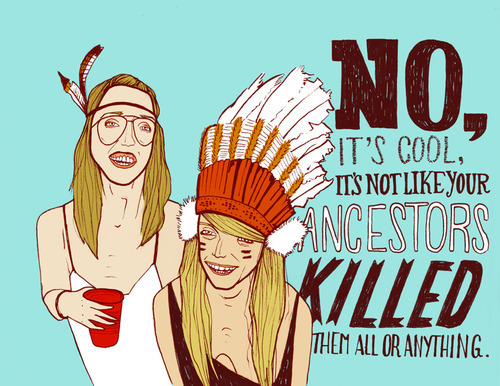
Case in point, Mr. Holt: Last summer's hottest hipster accessory of choice---the Native American headdress. Now granted, hipsters by definition are compulsive Cultural Appropriators with often deceptively deep pockets. They consume bits and pieces of popular, alternative, sub- and foreign cultures to achieve their allegedly socially conscious "bohemian chic." It's just a simple fact and I'm cool with that. But the hipsters got me thinking about consumption and advertising. What's been most worrying to me is the wholly dehistoricized, apolitical nature of consumption these days-- the ways in which this consumption assumes that dangerous "familiarity" that Holt describes and brings us right into the thick of issues of objectification, commodification and ultimately, what I see as racial, economic and social (in)justice issues. I see it everywhere from the hipster headdress right down to gentrification in places like Brooklyn and Harlem... a dangerous familiarity...  and one that apparently, can be purchased.

So in the beginning(ish) there was Eve....
Back in 1993, TIME Magazine came out with a Special Issue featuring the ironically named “Eve”-- a computer generated image of a woman  who was presented as the “New Face of America.” The caption on the front cover read: Take a good look at this woman. She was created by a computer from a mix of several races. What you see is a remarkable preview of" ..... dundunDUN “The New Face of America: How Immigrants are Shaping the World’s First Multicultural Society.”

Ultimately, Eve is what comes out of the melting pot. Eve is produced by technology, she's also explicitly gendered as female. There’s even an article in the issue that talks about how all the male computer programmers who created her, ended up falling in love with her. Eve becomes this object of desire and we are asked very explicitly on this front cover to look at her, exercise our scopophilia- our love, our desire to look and visually consume.

While this isn’t an advertisement per se, Eve represents WHAT and WHO marketers and advertisers are now both selling and marketing to. I see two things at work when we look at multiraciality and the market. The first is this idea that came out of the 1990s, that multiraciality as multiculturalism whether through it's colorful glossy print ads of black, brown and white people singing, dancing or walking around in their pajamas or through the physically mixed bodies of multiracial individuals or even via entirely constructed computer-generated images that we can attain and quite literally buy into a racial paradise. These images are inextricable tied up in ideas of the “future” of what Americans--- as in American “bodies” will look like in the years and decades to come.

The second is the ways in which race functions as a “technology” by hiding the ways in which we all have a relationship to the law and state power, yet this tenuous and violent relationship (often enacted on racialized and gendered bodies within the state) particularly in self-proclaimed progressive or liberal environments is covered up by ideas of fairness, equality, protection and inclusion and advertisers are feeding into this in a big way. There’s no denying that the state and the market are inextricably linked and that the market plays a huge political role in defining the state’s subjects and citizens. 

The cruel irony is that given proposed racist policies like Arizona's SB 1070, what would happen if Eve went to the southern border today? In today's racial climate, would Eve continue to be celebrated as the "face of America" or would she be sent packing "back to her country"?......

I'm really interested in the construction and use of the mixed body in contemporary advertising and it’s racialized and gendered implications particularly in relation to the state and national identity. In different manifestations advertisements have framed multiraciality and multriacials as commodity, product and at times even fetish-- something to be consumed, acquired and possessed. In the past decade there has also been a transition in the mixed-body from being mere product to now also being a visible and viable consumer and subject (see Kimberly McClain Dacosta's Making Multiracials  in which she discusses the politics of recognition that happen in the market and the ways in which that recognition can quite literally create a racial identity.)
I'll leave you with a few images from the European clothing company United Colors of Bennetton (whose ads were pretty controversial in the 90s), the Telefonica phone company, American Apparel, Levi's jeans, photos from the "Biracial photoshoot" on America's Next Top Model that was critiqued for putting models in "brown face" and a photo from a 2008 Allure spread entitled "Faces of the Future" in which multiracial models were used to mark an imagined "future."  


These Telefonica images are pretty creepy. To give you some context, these are computer generated images that state from left to right "The lowest rate calls from Japan to Scotland, from Turkey to Sweden and from Senegal to Germany." It's also interetsing to compare these creepy male-bodied computer generated images with TIME's  sexy female-bodied "Eve." Curious, curiouser...

This Levi's ad marks a particular moment in U.S. advertising in the 90s in which marketers were selling to a much younger, hipper demographic. This demographic was being told through images like this one that in the famous words of MJ, it doesn't matter if you're black or white, as long as you had these jeans, you were free and you could buy into a racial utopia.

Tuesday, December 7, 2010

"Skin" Trailer

Here is the 2009 documentary film trailer for "Skin Deep: The Sandra Laing Story".

Below is the trailer for SKIN the feature film starring Sophie Okonedo.
Should be fascinating....
U.S. DVD will be released in February 2011.


Thanks Caitlin!