Let me begin, if I may, by introducing this rather belated post with the powerful words of some scholars, poets, writers, and activists to set our scene:
"American history is longer, larger, more various, more beautiful, and more terrible than anything anyone has ever said about it--and that it belongs to him [the black child]. I would teach him that he doesn’t have to be bound by the expediencies of any given administration, any given policy, any given morality; that he has the right and the necessity to examine everything." (James Baldwin)
"It is in this space that we will find those words with which we can speak of Ourselves and Others. And by exploring this hybridity, this 'Third Space', we may elude the politics of polarity and emerge as the others of our selves." (Homi Bhabha)
" The effect of mass migrations has been the creation of radically new types of human being... people
who have been obliged to define themselves--because they are so defined by others-- by their otherness; people in whose deepest selves strange fusions occur, unprecedented unions between what they were and where they find themselves... To see things plainly you have to cross a frontier." (Salman Rushdie "Imaginary Homelands")
To survive the Borderlands
you must live sin fronteras
be a crossroads. (Gloria Anzaldua- full poem at the end of the post)
I've been feeling a lot like an oyster these past couple of years, working out, mulling over, rubbing painfully up against a little grain-- an irritant-- that made its way suddenly into my pristine little shell (although, perhaps, it had always been there). Now bear with me, I promise this image will (hopefully) make sense by the end of this.
 I began this blog back in 2009 as a response to a very particular moment in our ever-shifting, ever-challenging social terrain in the U.S. That moment was what I liked to call the time "We-Drank-That-Postracial-KoolAid-And-Almost-Died". It was a time of short-lived, but heady hope for a new America in the wake of President Obama's historic 2008 win. To that point, there are actually some really interesting reflections out there on how the visceral reaction against the post-racial moment (of which I was very much a part) in its fervor actually obscured the possibility that a particularly important and valid desire was being articulated. A desire, that perhaps, prematurely and albeit naively, declared itself into a celebratory daze despite all obvious evidence to the contrary.
Yet, arguably, the desire itself was not bad, wrong, destructive, oppressive, or misguided at all. Beneath all the la-dee-dah-ing, the desire was simple and not altogether new: a society in which race was not a thing that divided, was not a thing that subsumed everything else you were, where processes of racialization were obsolete because that power that fed on it with such insatiable voracity was at long last toppled. In this light, was it not an articulation of a desire for a "postracial" future when MLK in his now iconic (albeit much-coopted) speech said, "I have a dream that my four little children will one day live in a nation where they will not be judged by the color of their skin, but by the content of their character."? We hardened social justice critics, often eschew the I Have A Dream speech of MLK's for his more radical and his more incisive ones in warranted resistance to the normalization
 and domestication of MLK and the 1960s civil rights struggle more generally. But that dream he spoke of remains, as ever, a passionate one, a live one, an aspirational one, a good and valid one. Of course, the getting there is what thwarts us every time. We look for the messianic leaders, or the catch-all social-political dictums and prescriptions of colorblindness or multiculturalism, or the recognition and celebration of certain bodies or identities (like the multi-babies of the world) as panacea to fix things or just erase them from memory altogether. Meanwhile, a tormented America cries out silently at every turn beneath the cracked and rotted veneer of unity and diversity for racial redemption, a deliverance from the racial sins upon which it was built. But the American power recalcitrant, refuses to do the work and to understand deeply and profoundly that that road to redemption is long, arduous, and very possibly, never-ending. And that that road cannot and will not be crossed on the already broken backs of people of color. But the desire for "deliverance" in the post- civil rights era, as was so crudely and cursorily expressed through postracial rhetoric as was colorblindness before it, is in itself something that we should continue to grapple with and continue to hold our society and ourselves accountable for.
 In the often defensive and critical stance taken to make sure we STAY WOKE, perhaps, we're forgetting to give dreams a chance, and most importantly, to remain creative and imaginative. I've been starting to think that our spit-fire social media world has made our thoughts and our politics more reactive than anything else and for that reason, I retreated into my shell for well over a year to continue reflecting and thinking without necessarily feeling the need to send those half-baked strands and threads into the cyber ether. This post is more a reflection on a picture (or to follow my oyster metaphor, a pearl-- an ugly lumpy one at that) that is slowly beginning to emerge from some of my thinking on multiracial issues over the past year. Still half-baked, but ready for some preliminary putting out there.
The model upon which I developed much of the early blog content and the course I taught in Oberlin on multiracial identities relied heavily on the social justice frameworks which have been my bread and butter for over a decade now. Frameworks, which were based on the kind of powerful identity politics that shaped the social justice movements of people of color, women, and the LGBTQ community. My project, at its tender beating heart, was and continues to be a political one. Identity politics was the tool I had at hand-- one which I felt had been useful in bringing together, developing critical consciousness, and mobilizing communities. Yet, in my passion for developing a kind of radical or "critical" mixed-race understanding, I failed to ask, what for? Of course, I knew what for-- multi people needed to come together, needed to know "'bout themselves" and how we fit into the very salient racial histories and realities in America. But in declaring this, I inadvertently toed a very tenuous line that left me at risk of reducing and essentializing multi identities and experiences. My project was at once personal but also political. The personal project needed to be about fluidity and empowering self-identification, and a recognition of those third and fourth and fifth spaces we occupy as mixed folk. But the political one needed to be about critical consciousness building and understanding structures of power and oppression and inequality and how we were implicated in those systems. Reconciling those two is not an entirely easy task when multiracial people are so diverse and when the world is calling upon some yet nascent multiracial self-hood to represent itself in all its pretty glossy glory on the one hand, yet on another, being told in not so many words that it needs to take several seats 'cause folk is still out here struggling.
 Which brings me to the second reason I began this blog: to address what I saw as the increasing cooptation of multiracial people and identities to usher in the aforementioned post-racial era. I wanted to figure out how to temper that proclivity to make multiracial people the poster children for some brave new world. I felt that the multiracial students I was working with were hungering for a history, a name, tools to express who they were. Similarly, I was beginning to feel that the multicultural politics that became standardized and institutionalized in schools, college campus', workplaces, and even (disturbingly) in corporate America were creating a kind of diversity complex that was wholly reductive, essentializing, and even in more radical or resistant iterations of it, still grappling with how to account for the multitudes, the axes of difference, the intersections, and asymmetrical privileges and inequalities that all make up our social realities and identities. Why were all these categories or racial and ethnic differences so monolithic when the reality has always been far from that? These concerns prompted me to imagine that perhaps alongside the conversation of multiracial identities and experiences, we also needed to complicate and disrupt all these other categories that hem us in and make us recognizable or unrecognizable to ourselves, others, and the "state" writ large (and I evoke the state here, because identity politics as mobilized by social justice movements were every much about representation and the politics of recognition vis-a-vis state power as much as they were about creating community and building consciousness). And this worked in the context of higher education I was in. The course I taught and the work that emerged from it was really amazing. But, I soon left the hallowed halls of higher learning and perhaps it was then that I began to take note, however vaguely, of the little grain inside my shell.
I travelled to India for a year upon finding out about my birth story in my early twenties. That year was a trippy one for me and really complicated my thinking on race in ways that even years later I am still working out. Passing as I did for Indian and also realizing that my birth mother had actually never grown up in India, and instead identified much more with the southern African country in which she was raised, threw open so many issues about identity and origins, heritage, race, nation, and the complexities of migration that my personal history came to embody. People with whom I share my "whole" story are often amazed and encourage me to write a book or make a movie. Which is flattering, of course, but what I'm more invested in is demonstrating how unexceptional my story is. While the small details of it may be unique, the bigger themes are no different than so many other stories. And I think there is something important at stake in making stories like mine the norm instead of the exceptional, the Other, the spectacular. If our future is poised to recognize these "new" realities, perhaps, something important will be gained. I'm married to someone who identifies as multiracial and is Japanese and white-American. So while, that "multiracial" so called "new face" of America is being called into existence, he and I may inevitably be part of literally reproducing that future (as will the thousands of "new" families that are not only multiracial, but make up queer families, multi-religious and transnational families, etc. Indeed, the normative bounds of "family" are due to be disrupted and transformed). To be sure, imma need lots of reflection on raising African-Latino-Indian-Japanese-White-American children in a world and a society that's slow to catch up on changing realities in ways that are critical, meaningful, and committed to breaking down barriers instead of building them up sky-high. So, I take up these issues for myself but also for the family I might have and the world they might inherit.
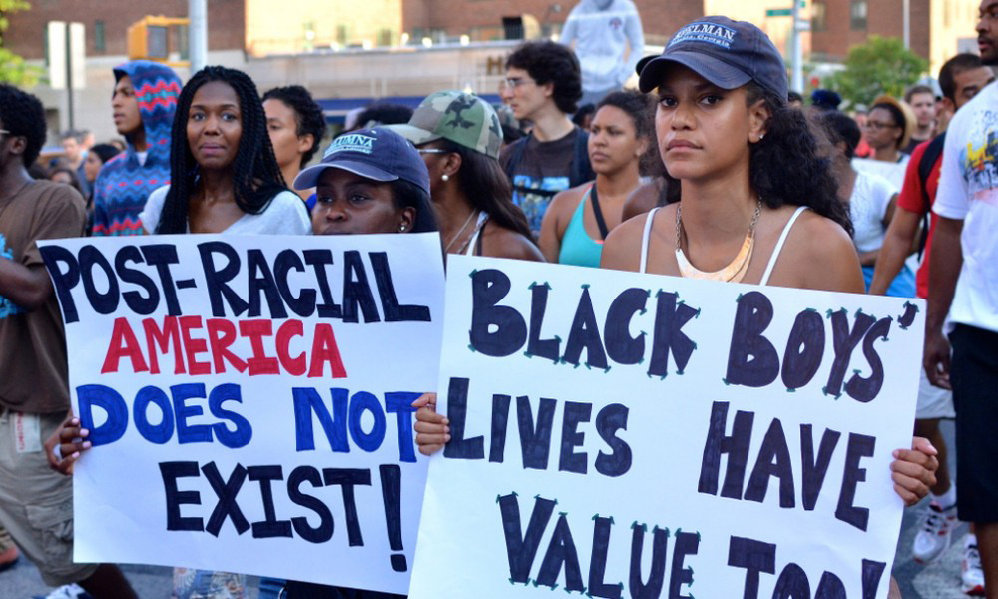
I've been studying Migration Studies at the University of Oxford since October and living in the UK has been a strange and enlivening experience. I also left the States, in the wake of the killing of Mike Brown and Eric Garner, the latter who hailed from my hometown of Staten Island, NY. It's been strange being outside of the U.S. and coming to a place like Oxford, in particular, at a time in which communities back home have been taking to the streets and we just may be witnessing one of the biggest social movements in my short life-time. During this time, I've wondered what place my previous work and thinking on multiracial identities have when people of color are being killed in cold blood? That multi stuff, I keep thinking was for those other days, not these days when the sky seems to be falling and America is waking up with a massive lurching hangover from its postracial sleep. I feel like I need to put away my multiracial hat and throw myself full on into the "struggle" lest my loyalties be questioned-- but then I realize no one is questioning those so-called loyalties but me. I realize, that while I'm good at talking that big talk, I didn't escape entirely unharmed from all the pressures of thinking of black as a monolith-- a conception that with a new generation is steadily being challenged. So on good days, I consider that it still is a really important and worthy project and not just some pet project. That my approach to multiracial issues actually has some interesting co-valences with "queer" critique, insomuch as I'm calling for a disruption of the normative and raising political concerns and questions about how power and structures are implicated.
In many ways, I've felt like those black artists and intellectuals who had come to Europe at some pivotal point in their lives-- and how that distance from the racial saga of the U.S. meant that they could for the first time think, reflect, and confront that beast in distinct ways. At Oxford I've had to rethink identity politics and multiculturalism in an academic and socio-political context that has critiqued it and declared them "failed," and "dangerous groupism." With multiculturalism, that backlash has been the particular pet project of a growing conservative and extreme right governments against the social policies which many European nations happily adopted and institutionalized in the 80s and 90s. But the backlash, warranted or not, has been picked up and academics have offered new terms like "superdiversity" (Vervotec) which aim to get at what multiculturalism seemed to have missed-- the layers, the growing number of axes of difference people occupy and identify with. It's also been used as multicultural was, to describe new spatial realities, material practices, and zones of contact in global cities and elsewhere. Of course, the term superdiversity is not without its strong critiques. Chief among them, is how new is this really and what are the political implications-- will we start speaking of a superdiversity politics and to what extent can it resist cooptation (much like the multiracial movement in the U.S. to get more Census categories)? The mostly UK-based and academic-driven conversation on superdiversity is an interesting one and one that I think could have interesting reverberations if it does not fall prey to the same malaise of multiculturalism.
Frankly, far from enlightening, my thinking during my time in the UK has been (until recently) rather
 muddled. While I organized a solidarity march for Ferguson and other activities to open up dialogue on race here at Oxford, it's also been a really trying time for me to see if my tools work-- if they are at all translatable and intelligible in a context like the UK (which may have more in common with the U.S. than it'll ever own up to). I've had to bring race into the space in ways I never had to before, in ways that have angered me, opened up old wounds, and left me feeling exposed, tired, and confused. I've had to talk about race to peers who, understandably, can't quite grasp its meaning from their diverse national backgrounds. Why would black lives matter here? I struggle with not wanting to practice American "cultural imperialism" and bring in these U.S. social justice frameworks that really actually don't fit. While still grappling with my belief that racism is globalized and that is a reality we need to acknowledge from outside our national bubbles. So I've started working with others on really important, albeit exhausting, process of making connections, provoking expansive analyses about the systemic and root causes of issues that may have different area codes and time zones, but actually beneath the surface really are very similar. The black lives matter message can be imagined internationally as a powerful call for us to reflect on who "matters" in the different places we call home.
  I already see how the "Black Lives Matter" movement back home is perhaps marking a new and inspiring activism and politics of identity and social justice that is responsive to a complex, diverse, and multiply-situated reality. Started by a Nigerian woman and two queer black women, the organization Black Lives Matter and the mobilization of orgs like the Dream Defenders have fostered a desperately needed expansive analysis and understanding of the structures of state- sanctioned violence and racism in the U.S. and globally. It's reviving the kind of international black politics of Angela Davis, Malcolm X and others. They've also spoken about black struggles right along with women of color, queer and trans struggles, and class struggles. In the UK there was a critical time when "Black" was an identity taken up by South Asians and other racial and ethnic groups in a kind of collective politics. Further back in the day, during the time of the Haitian revolution and its foundation as the first black republic, all of those first citizens of Haiti (including white people, for indeed there were white people who took up the cause alongside the black revolutionaries) all claimed the identity "Black." This shows us that our activism and our politics can be "hybrid" and multiracial (and in fact most of the poc movements have been) and that we must always call upon ourselves to reimagine our politics of identity in creative and transgressive ways.
I've often felt like Ralph Ellison who wrote " I was taken very early

I titled the blog and subsequent work, including the course at Oberlin "Mixed Dreams" and I seem to be waking up from that dream committed to seeing how some of those dreams can constitute a reality. There is really amazing work that's come out over the years in the "critical mixed-race studies" world, including DePaul's conference of the same name and the site Mixed Race Studies is always updated with compelling and important material. To the extent that wider society will pick things up and stop reproducing the same tired message about our multiracial future is yet to be seen. But these are indeed difficult, but exciting times to be doing a little dreaming.
So I'll keep working on that grain in my shell to see what dreams may yet come and what brave new futures we can create.
****
To Live in the Borderlands
Gloria Anzaldua
To live in the Borderlands means you
are neither hispana india negra espanola
ni gabacha, eres mestiza, mulata, half-breed
caught in the crossfire between camps
while carrying all five races on your back
not knowing which side to turn to, run from;
To live in the Borderlands means knowing
that the india in you, betrayed for 500 years,
is no longer speaking to you,
that mexicanas call you rajetas,
that denying the Anglo inside you
is as bad as having denied the Indian or Black;
Cuando vives en la frontera
people walk through you, the wind steals your voice,
you're a burra, buey, scapegoat,
forerunner of a new race,
half and half - both woman and man, neither -
a new gender;
To live in the Borderlands means to
put chile in the borscht,
eat whole wheat tortillas,
speak tex-mex with a brooklyn accent;
be stopped by la migra at the border checkpoints;
Living in the Borderlands means you fight hard to
resist the gold elixir beckoning from the bottle,
the pull of the gun barrel,
the rope crushing the hollow of your throat;
In the Borderlands
you are the battleground
where enemies are kin to each other;
you are at home, a stranger,
the border disputes have been settled
the volley of shots have shattered the truce
you are wounded, lost in action
dead, fighting back;
To live in the Borderlands means
the mill with the razor white teeth wants to shred off
your olive-red skin, crush out the kernel, your heart
pound you pinch you roll you out
smelling like white bread but dead;
To survive the Borderlands
you must live sin fronteras
be a crossroads.
are neither hispana india negra espanola
ni gabacha, eres mestiza, mulata, half-breed
caught in the crossfire between camps
while carrying all five races on your back
not knowing which side to turn to, run from;
To live in the Borderlands means knowing
that the india in you, betrayed for 500 years,
is no longer speaking to you,
that mexicanas call you rajetas,
that denying the Anglo inside you
is as bad as having denied the Indian or Black;
Cuando vives en la frontera
people walk through you, the wind steals your voice,
you're a burra, buey, scapegoat,
forerunner of a new race,
half and half - both woman and man, neither -
a new gender;
To live in the Borderlands means to
put chile in the borscht,
eat whole wheat tortillas,
speak tex-mex with a brooklyn accent;
be stopped by la migra at the border checkpoints;
Living in the Borderlands means you fight hard to
resist the gold elixir beckoning from the bottle,
the pull of the gun barrel,
the rope crushing the hollow of your throat;
In the Borderlands
you are the battleground
where enemies are kin to each other;
you are at home, a stranger,
the border disputes have been settled
the volley of shots have shattered the truce
you are wounded, lost in action
dead, fighting back;
To live in the Borderlands means
the mill with the razor white teeth wants to shred off
your olive-red skin, crush out the kernel, your heart
pound you pinch you roll you out
smelling like white bread but dead;
To survive the Borderlands
you must live sin fronteras
be a crossroads.